By Victoria Worsley FG(UK)
While we think of anxiety and stress as mental or emotional states it is important to remember that that is part of a very complex story that encompasses a cascade of physiological events throughout our whole selves. There has been much research into the delicate flux and balance held in the (autonomic) nervous system between arousal and relaxation as we go through the day; the changes triggered throughout our systems (eg vascular, pulminary, muscular, digestive, immune) enabling us to meet periods of challenge effectively and, just as importantly, come back to a quieter, easier place when circumstances allow. There is also much written about how this process evolved to cope with more immediate threat to life and limb, requiring immediate action -eg fight or flight - and that in our modern life where such action is often inappropriate (best not to hit the boss or landlord or run away from an exam or meeting) or not possible (can’t hit a bank or run away from the state of the employment market effectively) there can be difficulty in discharging the arousal and returning to a more neutral state. I am also pre-supposing the idea that difficulties arise not so much from experiencing day-to-day stress - which is unavoidable in life and is to a degree a positive factor in maintaining health in fact - but when it becomes more that we can deal with and return to base easily: when through a single trauma or repeated unresolvable situations the balance tips into a more continuous state of arousal with all the physiological impact that has in so many ways: suppressed immune system, problems with digestion, breathing or blood flow, muscular imbalances or issues with prioritising sensations or judging situations to name a few possibilities. Assuming this background it is possible to accept that there may be many different ways of intervening by addressing one or more different aspects of the syndrome and so begin to impact on the whole pattern. My intention is to say something about how the Feldenkrais Method contributes here.
The Feldenkrais Method is a practical way of enabling us to explore our habits and patterns of behaving, thinking and doing through movement and to learn new possibilities or re-learn old ones we have lost. Movement is essential to life. There is no breathing, eating, drinking, excreting, reproducing, locomoting or self-care that can happen with out it - which makes it a powerful way in for enabling change: so many aspects of our selves and so many of our systems are involved in or affected by movement. But interestingly, a significant amount of human movement has to be learnt and that is key.
It is the nervous system that enables movement. Without instructions given by the nervous system (in the context of much sensory information collected also by the nervous system) nothing moves, nothing happens. But unlike most other animals our nervous systems are not mostly ‘wired up’ at birth. Think of a herd animal like a deer that must get up and run with the herd shortly after its birth or it will be someone else’s lunch - and then think of the random movements our babies make and the time it takes to learn to roll, crawl, sit, stand, walk, and one day run. It is that learning process that actually ‘wires us up’ creating highly complex web-like patterns of connections in our nervous systems that enable us to do all the things we need or want to do. Of course being human and our genes has something to do with the unfolding of the process, but the patterns of connections we make in our nervous systems are also the result of our individual processes of learning through different environments, life experiences and life choices, making each of us unique. On a simple level Dr. Feldenkrais used the example of a dog that will bark the same and be understood the same by other dogs whether it is born in Italy, Japan, England or Russia –as opposed to a human who will not. Or you could imagine seeing a friend at the top of the road: you may not be able to recognise them from their face, hair or clothes at that distance, but you will know them from a gesture, from the way they hold themselves, the way they walk. This ability to learn, develop and adapt is the thing that makes us so different from each other. It is also partly why we are such a successful species - and why we can find ourselves in such trouble too.
That ability to learn includes the ability to make mistakes. It is through making mistakes that we find out what works and what doesn’t and gradually we learn to eliminate mistakes and find how to do something better. But of course we may not learn perfectly. At some point we may find that some of the learning we did does not help us so well, or some was missed out or some things have been learnt that we needed as the best way we could deal with something at the time but are not so appropriate or helpful now. Maybe the result of years of learning eventually involves back pain or knee pain or breathing trouble or difficulty with balance or limitations that get in the way of improving a skill – and maybe it involves a pattern of chronic anxiety and stress.
For in amongst those patterns we have developed are the ways we have learnt to protect ourselves in times of difficulty. We have learnt through trial and error, through experience what feels safe and not safe, and how to cope with times that are difficult or threatening. And we may have done so with successful outcomes or not such successful outcomes depending on our skills, belief in our capabilities or what was actually possible at all in that situation at that time. And so the result may be that somewhere along the line our life experiences have not allowed the discharge of arousal too many times or have taught us that we need to stay vigilant for some reason - that we cannot expect to be safe even in many ordinary day-to-day situations- and that may have become embedded in the patterns of how we feel ourselves, hold ourselves, breathe and move. Some muscles may have tightened to shut out feelings or sensations or set into some aspect of the reflexive curling pattern of the torso for self-protection. Some muscles may have correspondingly habitually lengthened and lost power, become exhausted or lost tonus. We may be ‘pulling ourselves together’, ‘holding ourselves up’, or ‘holding our breath’. We may have lost the sense of the ground and our skeleton as supportive, of ourselves as an integrated whole. The results involve behaviour of the muscles, tendons, fascia and skeleton and so become an intrinsic part of our movement patterns. But that means we can approach them through movement too.
Of course we can stretch or massage individual muscles to loosen them when they are tight; we can exercise individual muscles or muscles groups that have lost their tonus to strengthen them again; we can manipulate the skeleton to put it back into alignment and many of these things can and do help. But working in this way can be a hit and miss affair as far as learning a new movement pattern is concerned. The nervous system works in relation to what you want/need to do in the world rather than operating individual muscles or groups of muscles without such an intention. Any such action involves changes throughout the whole system not just in one muscle or group of muscles. So unless the new tonus or alignment is recognised deep down as something that can be integrated with the whole of the neuromuscular system for use it is very possible that a muscle mechanically loosened/strengthened or a skeleton mechanically ‘put right’ may not be enough to facilitate a different choice and can even go straight back to its old level of tension or position as soon as the instruction comes to walk, run, reach for the tin of beans. Those activities have been wired into a very complex pattern that has been learnt over (potentially) many years incorporating an organisation of the skeleton; levels of work or release throughout the whole muscular system and corresponding response throughout the fascia; ways of breathing, balancing and adapting to gravity - but if you have learnt a new pattern of movement, it is a whole new pattern wired in, ready and available to use when you take that step, run, reach for the tin of beans involving potentially all those aspects of the activity.
It may take the person a while to learn to create enough new choices or it may take many repetitions of learning for the person’s system to really adopt something new but it can also happen very quickly on occasions. After all, following from Darwin’s theory of evolution, we have a tendency to adopt the most successful pattern available to us at the time to improve our chances of survival. It is most likely to happen - as most learning does – gradually, bit by bit, two steps forward one step back, a leap here, a plateau there, over a period of time.
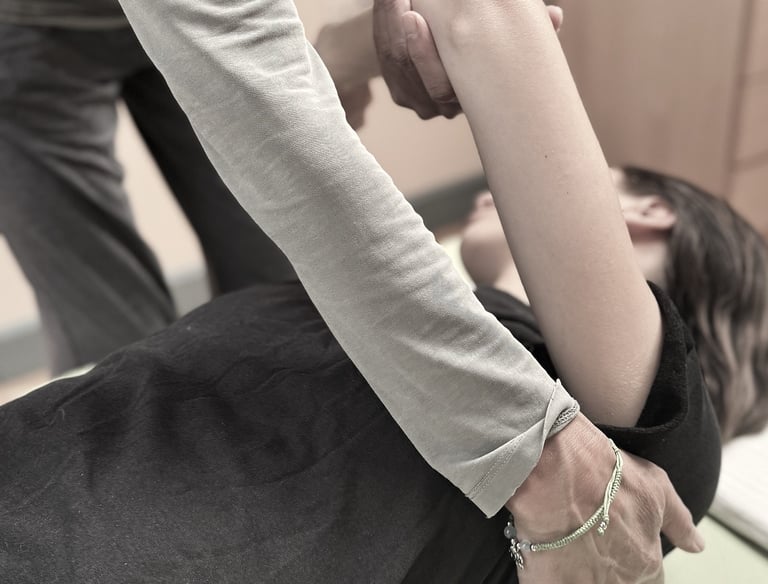
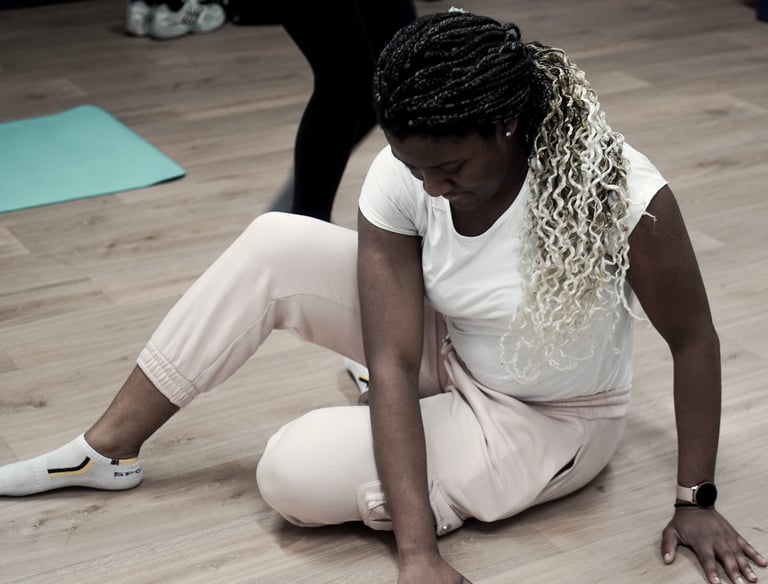
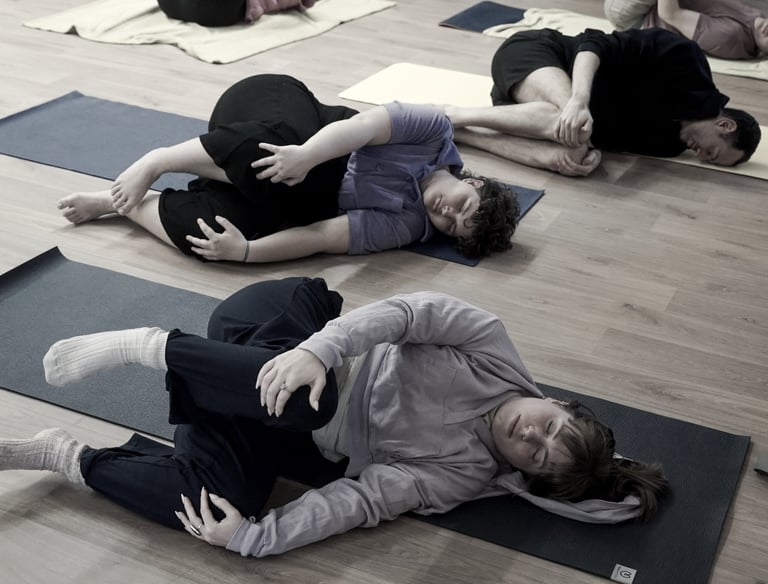
This kind of learning lies at the heart of The Feldenkrais Method. As Dr. Feldenkrais often said his method helps you ‘to learn to do the thing you already know in many different ways’. So then you don’t have to make the choice that involves the anxiety/stress pattern just because that is the only choice you have got. You can work with the Feldenkrais Method in classes called ‘Awareness Through Movement’ or one-to-one through gentle hands-on sessions called ‘Functional Integration’. Both are mainly done lying down so that your system doesn’t have to be occupied with keeping you upright leaving you more free to explore. In both you will begin to notice how you respond to an invitation to do simple movements and variations of movements that may lead to or become part of a bigger more complex movement (either via a verbal invitation or through suggestions given by gentle touch). You will be asked to notice what parts of yourself you can feel, what parts are clear to you or not so clear; what parts of you join in the movement, what parts don’t and how the parts of you relate; to what degree you can use the ground for support, balance, traction or transmission of force; how much and what kind of effort you make and whether it is appropriate for the movement; what choices you have in the quality of the movements you make; how you use your breath - and then to play with a variety of possibilities noticing the differences that they make. In short, a learning experience is constructed through which old patterns are recognised and new variations and choices can be discovered which may incorporate a different way of being, doing, feeling.
As new ways of moving and behaving are discovered, the patterns of chronic anxiety or stress begin to lose their compulsive grip. Sometimes they simply unravel gently as newer more supportive patterns become available and take over without any great emotional upheaval: just the gradual sensation of being able to cope better and enjoy life more. Sometimes there is a process of recovering memories or feelings that have been blocked to protect you from being overwhelmed at the time, or the emergence of experiences that need to be completed in some way. It may be that your Feldenkrais Practitioner also has the skills to see you safely and constructively through this period or it may be that you need a councillor or psychotherapist to work with as well. Or you might use Feldenkrais simply to augment, integrate, deepen or open up the work you are already doing with a therapist or councillor and improve basic self-supporting skills. Indeed this work can work very well alongside many other kinds of processes or therapies that are working with different aspects of this very multi-faceted syndrome.
Further reading:
Books:
‘The Elusive Obvious’, ‘The Potent Self’ Dr. Moshe Feldenkrais
‘Trauma and the Body’ (a sensorimotor approach to psychotherapy) by Ogden, Minton and Pain
‘The Body Bears the Burden’ by Scaer
‘The Body Remembers’ by Barabara Rothschild
‘Waking the Tiger’ by Peter Levine
Articles
‘The Somatic Dimensions of Emotional Healing’ by Ralph Strauch (Feldenkrais Practitioner) available at http://www.somatic.com/articles.html
Find a Feldenkrais Teacher:
www.feldenkrais.co.uk (Feldenkrais Guild UK)
Victoria Worsley FG(UK) can be contacted at: 0771 1088765,
www.feldenkraisworks.co.uk find Feldenkrais Works on Facebook