Feldenkrais and Movement for Performance (Professionals)
"When you know what you want, you can do what you want"
MOSHE FELDENKRAIS
The Method
The Feldenkrais Method is increasingly a part of the performance world, best
known to physical theatre performers, musicians and dancers it is now finding
its way into more traditional acting through its wider inclusion in more drama
school trainings and at institutions including the RSC.
Developed by Dr. Moshe Feldenkrais (1904-1984), an eminent physicist and
judo expert, it is one of the most cutting edge body/mind or 'somatic'
methods available today. Based on sound neurological principles, it uses carefully
crafted lessons to explore each participant's own particular patterns
in relation to a wide range of movements and open up new choices so that they
can do what they want more easily and with less strain.
The Method's application is manifold – it can be enormously helpful
to anyone from office workers to sportsmen and women, for improvement in skills,
'posture', range and quality of movement, for recovery from injury,
brain injury or chronic pain. It can also be used in conjunction with psychotherapy
and for personal growth. Its central focus is on 'awareness' -
helping participants to become aware of what they actually do, their habits
and patterns at larger and more minute levels: only when you know what you
do can you make a new choice.
The Benefits and Importance Specifically for Actors and Performers
The Method can help an actor or performer be upright, move with greater ease
and grace, and have a greater range of possibilities and choices. It also
reduces the likelihood of injury and can help keep a good range of movement
for longer in later years. All pretty useful in this business. However there
are many other more profound and very interesting aspects to engage performers/actors
at every stage of their careers. Here are some I have already identified (no
doubt there are more it would be great to explore):
-
The focus on awareness is key for actors and performers in finding
out more about their habits through simple movements: and in doing that they
can also find out more about what they bring on stage with them before they
'do' anything. In a simple way it can help close the gap between
what they think are doing (trying to communicate) and what they are actually
doing (what the audience gets): between 'inner' and 'outer'.
For younger actors it can be a journey of discovery, for experienced actors
a chance to deepen their awareness as well as open up any 'ruts' or performance
habits that they may have got into - an easy thing to happen under the particular
pressures of having to make things work in a short time-scale.
- The lessons ask the participants to listen to themselves, and move
in relation to what they can sense rather than act on an idea of what a movement
is. Sound familiar? It involves being 'in the moment' which is
crucial to imagination, truth - and comedy – in performance. Even for
experienced performers, spending time paying attention to what they do in
relationship to a simple movement can always bring new discoveries and improvements
which can carry through into the more complex situation of being on stage.
- Similarly, having the opportunity to notice subtle sensations and
differences and listen to yourself more carefully can promote or deepen subtlety
in performance. It also easily translates into being aware of, listening and
responding to others on stage with more sensitivity.
- The method involves noticing and finding ways to reduce unnecessary
effort. Ie: Ways to do less. Identifying ways they do more than they need
in a simple action can help a performer find the point when they are 'doing
too much' in other areas, including – very usefully - in performance,
while the pressures of making and performing regularly can often lead to over-work
in many other aspects of their life too.
- Increasingly as I work with people in classes and individual sessions
I see and feel in them the embodiment of experience, of feeling and emotion
states. So I have a current hypothesis that the method can enable performers
to become better able to sense the physiology of their own feeling and emotional
states which can in turn help them portray what they want more clearly. It
may also mean they can repeat without losing intensity and creativity more
easily too since they can find that feeling state in themselves again as something
tangible. This kind of approach works largely through non-cognitive kinds
of memory so that re-finding works automatically and through sensory association
rather than having to do anything consciously. In fact I think sensing of
inward physiological states might often be one of the ways that actors navigate
their way through a piece even if they are not consciously aware of it at
all - I know that is true for me. For those who know their Stanislavsky, I
believe this has a profound resonance with his idea of 'psycho-physicality'.
It is an area I would be interested to explore further.
- The lessons often involve orientation and relationship to space and
include a crucial understanding of how the eyes lead/relate to the rest of
movement all of which translates directly into performance (especially on
stage).
- Timing, rhythm and focus – three essential tenets of performance
(especially stage) are all there in this method and can be pointed up and
brought out in the lessons.
- The Method includes very interesting and useful specific breathing
and voice lessons but attention to breath is part of just about every lesson.
- Finally and crucially: there are no rules in the Feldenkrais Method,
no insistence on always standing in this way or that or never doing x or y.
There is no special dogma or right way to do something. It is all about creating
a place for the participant to explore/find out something about themselves
at what ever stage they are at, how they do things and what other possibilities
they can discover - not about telling them what they should or shouldn't do
and interfering with or dictating their own artistic process. In fact it is
more about finding ways to interfere with their own process less.
Ways of doing it
I am really open to any more collaborative or research Ideas. However the
basic tools are:
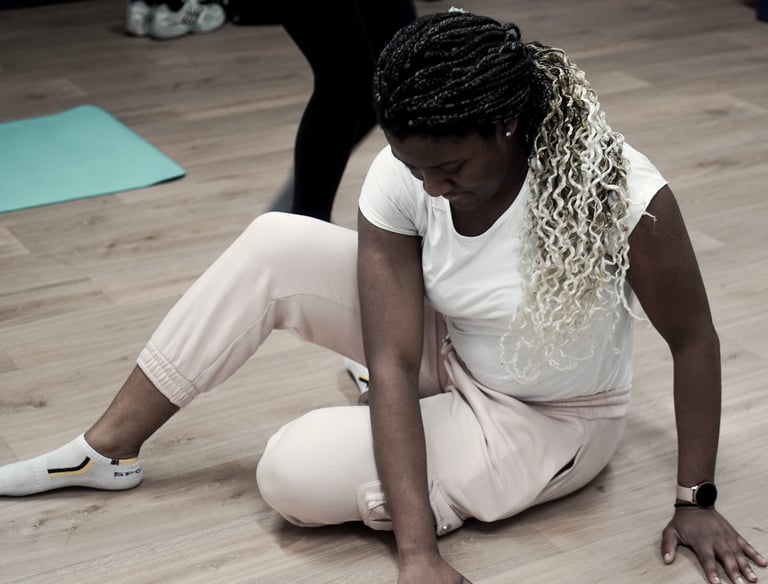
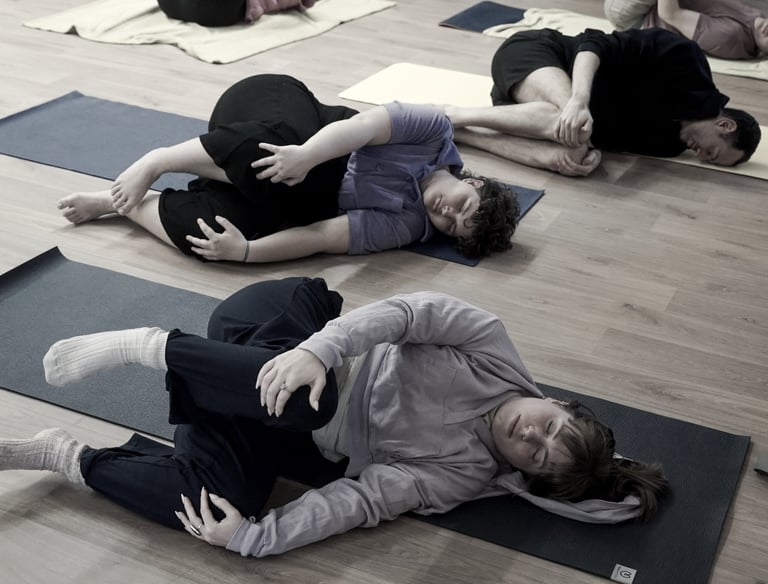
1 hour (or less) lessons for groups (Awareness Through Movement) which can
be (for example):
- used daily, weekly or structured into half day/whole day/weekend/week workshops
as pure company/personal development time
- used daily, weekly or structured into half day/whole day/weekend/week workshops
as part of research and development for a project either to address something
specific or integrated into the work to inform the whole process
- incorporated throughout rehearsals to inform the work or to address something
specific
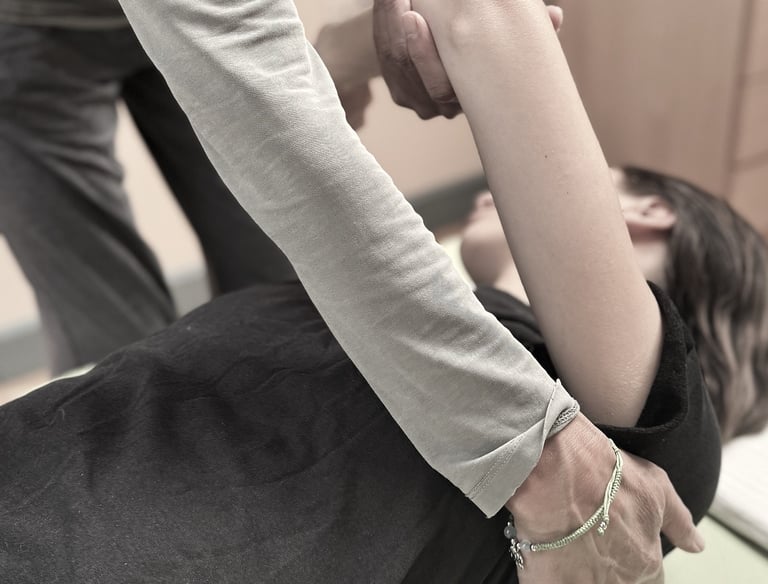
1 hour individual sessions (Functional Integration) usually on a low wide
table in which the Feldenkrais Practitioner uses gentle touch to guide movements
rather than the verbal guidance of Awareness Through Movement lessons. These
sessions can be more specifically focussed to an individual performer's
interests or needs and address any pain or difficulty as well as improving
particular skills.
Victoria Worsley has been an actor, theatre-maker and movement director for
over 20 years, (including being AD of Jade for more than 10 years: a company
which operated in that place where new writing meets physical/visual work).
She discovered the Feldenkrais Method 23 years ago while training in performance
with Monika Pagnuex and Philippe Gaulier in Paris and finally made her way
to the Feldenkrais Professional Practitioner Training in the UK in 2003 (funded
by ACE). She teaches Feldenkrais classes at drama schools and for theatre
companies and Individuals. She also has a public practice in North London.